
November 23, 2026
Film Review: La bola negra
Pascale Vinkhuyzen
When you picture Saint Sebastian, if you can conjure an image at all, it is likely of a beautiful, half-naked young man, tied to a tree, pierced with arrows. This episode from the saint’s story is actually not the one by which he met his untimely end in AD 288, but it is certainly the most famous, and the most recreated by artists in the centuries since. If you know the Saint from these paintings, you might not know he was a Roman soldier who was persecuted and put to death by the emperor Diocletian due to his Christian faith.
It is these depictions of the saint pierced with arrows that cemented his status within queer culture, where his image has served as an icon, an erotic symbol and, at times, a coded means of recognition between gay men. Sebastian’s many associations, the homoerotic subtext of the arrows, how he tried to hide who he was, and the suffering he endured have influenced gay men from Oscar Wilde to Keith Haring.
So too, it would seem, for Javier Ambrossi and Javier Calvo, known together as “Los Javis”, who directed the Spanish-language queer epic La Bola Negra, co-written with Alberto Conejero. In the opening sequence which takes place in 1937 during the Spanish Civil War, we meet our protagonist as he flees Italian forces (and yes, his name is Sebastian too). He scrambles through a ruined church to escape gunfire, pulling himself up a fallen statue of Saint Sebastian and using its arrows as handholds; the image of the saint’s martyrdom quite literally becomes his means of escape. The image is gorgeous, as is the entire film. You would be hard-pressed to find a shot in this picture that couldn’t be framed and hung on a wall.
The title La Bola Negra comes from a lost play by Federico García Lorca, of which only four pages have survived. The surviving fragment is only four pages, but the play’s broader premise, as recounted by those familiar with it, follows a young gay man rejected from membership at a casino because of his homosexuality. Besides Saint Sebastian, Lorca is the other patron saint of this movie. If you aren’t familiar with his work, it might be worth doing a bit of background research, or you can do what I did and spend the evening after your screening doing a Google deep dive. In any case, it is worth knowing that Lorca was a gay poet and playwright who was assassinated in 1936, at the age of 38.
I felt similarly out of my depth at moments when it came to the history of the Spanish Civil War (for example, if you don’t know what happens at the Sanjurjada, you may want to bone up). The movie is complex and long, and follows different timelines. The emotional heart of the film lies with Sebastian (played by singer/songwriter Guitarricadelafuente in his film debut), who is forced to join the Nationalist forces in order to survive. There are some wonderful sequences once he has joined the army. It’s a beautifully drawn paradox, entirely shown and not told, that Sebastian now finds himself in a deeply homosocial setting but is more uncomfortable and frightened than ever of his own identity.
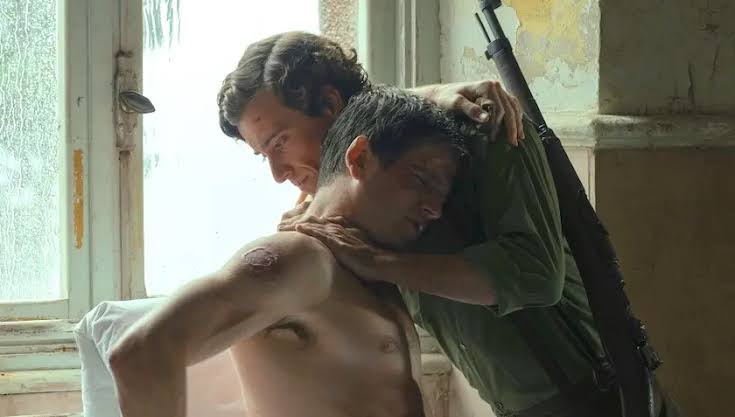
He is eventually put in charge of guarding a young prisoner, Rafael Rodríguez Rapún, a former lover of Lorca played by Miguel Bernardeau. I first discovered Bernardeau in the bonkers Spanish soap Elite, and he is an absolute highlight here, delivering a beautiful, heartbreaking performance. Though Guitarricadelafuente has his namesake, Bernardeau comes closest to embodying the film’s Saint Sebastian. He suffers, is broken and meets a tragic end, and Los Javis present his beautiful face and battered body again and again, leaving us both drawn to and repelled by this doomed young man.
In the 2017 timeline, we follow a young historian, Alberto, who receives an unexpected inheritance from his estranged maternal grandfather, and must go on a journey to discover his own providence. Alberto is openly gay and lives with his boyfriend in Madrid, an unspoken reminder of how much can change in a lifetime. The inheritance he receives connects Alberto to Lorca, but also to his grandfather, with whom he slowly discovers he has much in common. In this section, we get a standout performance from Lola Dueñas as Teresa, Alberto’s mother. Dueñas delivers a caustic, voracious performance of a damaged woman who never learned to lower her fists. Though there aren’t many women in the film, Teresa makes her presence felt, complicating the film’s exploration of inherited trauma and concealment.
It’s also a great pleasure to see Penelope Cruz, who shows up for a short sequence where she plays a cupletista who comes to entertain the troops. While they chat backstage, she offers Sebastian a moment to dream about different ways of life, away from the rigid masculinity of the army, a life of freedom that could be within reach if he can just survive the war. Between her performance this year in The Invite and this picture, it’s a consummate pleasure to be reminded what an exceptional actor she is.
At 159 minutes, La Bola Negra is undeniably sprawling, and you can’t convince me there weren’t a few sequences that could have been trimmed. But the best way to watch it is to give yourself over to it. Los Javis are playing with big ideas, and they hit far more often than they miss. More than anything, it is a film about the inheritance of queer history: when queer lives have been marginalised, erased or left out of the historical record, their stories survive instead through symbols, shame, art and the fragments left behind. Its three narratives, for all their occasional meandering, have something rich and worthwhile to say about gay identity, particularly the ways queer people contort and confine themselves in order to exist, and what they lose in the process.
Runtime: Listed as 159 minutes, UK Rating: 15